What Is Altinha? The Complete Guide to Brazil's Beach Game
Updated July 2026
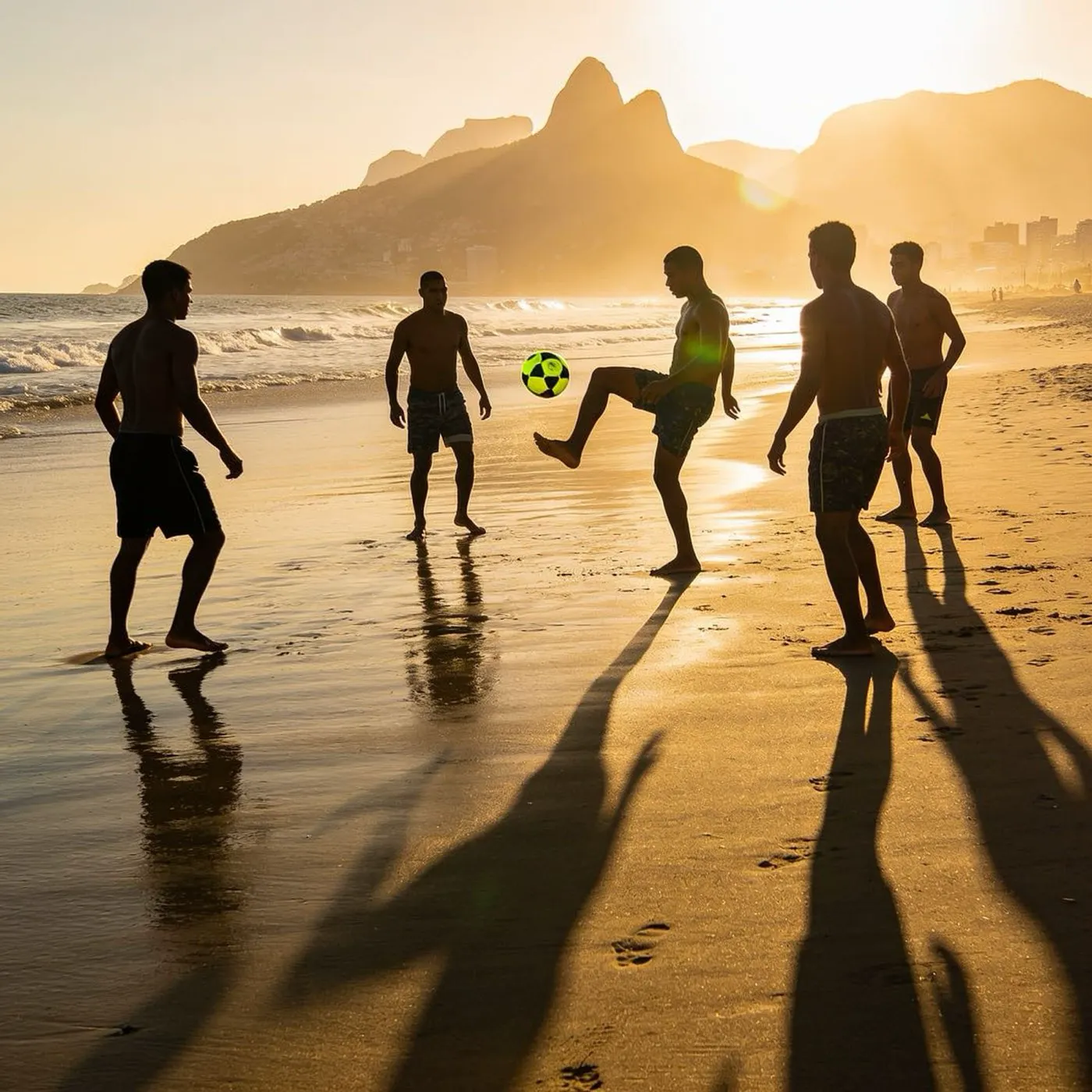
Altinha (Portuguese for "little high one") is Brazil's barefoot beach keep-up game: a circle of friends keeps a ball in the air using feet, thighs, chest, shoulders and head — everything except hands and arms. No goals, no teams, no score. The only rule that matters: a bola não pode cair — the ball can't drop.
Where Altinha comes from
Altinha grew up on the beaches of Rio de Janeiro — Ipanema, Copacabana, Flamengo — alongside its competitive cousin footvolley. While footvolley became an organized net sport, Altinha stayed what it always was: a social game anyone can join. Walk any carioca beach at golden hour and you'll find circles of players trading touches at the waterline. In recent years short-form video has carried the game far beyond Brazil, and circles now pop up from Miami to Lisbon to Sydney.
The rules (all of them)
- Form a circle. Two or more players, usually three to eight. No teams.
- Keep the ball up. Any touch except hands and arms: feet, thighs, chest, shoulders, head. The one rule that matters: a bola não pode cair — the ball can't drop.
- Set before you shine. A "set" is a soft, controlled touch that hangs the ball in easy reach of the next player — it's the most respected skill in the circle. Good players serve their neighbors first and save the flair for the right moment.
- Style is the score. There are no points, but everyone in the circle knows the difference between surviving a rally and owning one. Tricks that keep the flow alive — a no-look pass, a chest stall, a bicycle kick that lands softly on a friend's thigh — are the whole game.
That's genuinely it. Some circles play variations — counting consecutive touches, "one-touch only" rounds, or shrinking the circle — but there is no federation, no referee, and no score.
The next level: 2v2 in a circle of four
Once your crew is comfortable keeping the ball up, try the way experienced circles actually play: four players, two informal pairs. Set the player next to you with a soft touch, then attack and defend against the pair across from you — driving the ball at them with pace and style while they scramble to control it and counter. Nobody keeps score, but everybody knows who won an exchange. This is where the most fun in Altinha lives. And if you can land a trick mid-rally — a bicycle kick, a no-look flick — without breaking the flow, even better: keeping the rally alive while showing off is the whole art of the game.
How to play: the three touches every beginner needs
1. The thigh cushion
The most forgiving touch in the game. Let the ball drop toward your thigh, lift your knee to meet it flat, and cushion — don't kick. The ball should pop 30–60 cm straight up.
2. The instep lift
The classic keepy-up. Contact the ball with your shoelaces, toes slightly up, ankle locked. On sand, plant your standing foot deep and strike a touch earlier than you would on grass.
3. The chest set
Lean back slightly, open your chest, and let the ball hit the flat of it. Used to reset a wild ball into an easy touch for the next player — the most valuable skill in a circle.
Altinha vs footvolley vs keepy-ups
| Altinha | Footvolley | Keepy-ups | |
|---|---|---|---|
| Players | 2+ in a circle | 2v2 over a net | Solo |
| Scoring | None | Beach volleyball rules | Count your touches |
| Goal | Cooperative flow | Win the point | Personal record |
| Ball | Same FT-5 style footvolley ball works for all three | ||
The ball: why Brazilians don't use a regular soccer ball
A match soccer ball is built for boots and grass: firm, high-pressure, high-bounce. Altinha is played barefoot, so the ball that dominates Brazilian beaches is different — the FT-5 style footvolley ball:
- Size 5, about 22 cm (8.66 in) across — full size, familiar flight
- Softer, lower-pressure shell — no sting on bare feet, chest or head
- Laminated soft-touch panels with a waterproof cover, made for sand and water
- The look: the classic Rio colorway is vivid yellow with black triangular panels — recognizable in every viral beach clip
Want the real thing? We ship the genuine Mikasa FT5A Goal Master — the yellow/black Altinha ball — free across the US from US stock, with 2-day delivery and an optional pump + needle kit.
Get the Altinha Ball →Frequently asked questions
What does Altinha mean?
"Little high one" in Portuguese — named for the game's whole objective: keep the ball high.
How many people do you need?
Two or more. Three to eight is the sweet spot; circles are open, so people join and leave freely.
Do you need sand to play?
No — beach sand is the classic setting, but Altinha works on grass, in parks, and on the street. Barefoot on sand is the tradition.
Is Altinha good exercise?
Very. It's continuous low-impact movement — expect surprising soreness in your hips and core after your first long session.
Is it the same as footvolley?
No — footvolley is a competitive net sport; Altinha is a cooperative circle game. Same ball, same touches, different spirit.
← Back to the store · Shipping & Returns · @brazilaltinhaball